Construction Site Safety and Compliance Checklist for Australia

Construction site compliance is an essential responsibility for Australian builders, construction businesses, subcontractors and labour hire providers. From work health and safety (WHS) obligations to worker qualifications, site inductions, incident reporting and accurate timesheets, businesses need reliable processes to keep workers informed and records up to date.
Managing these responsibilities across multiple projects can become complicated, particularly when employees and contractors work at different locations or on changing rosters. Missing documentation, expired licences or incomplete inspection forms can create avoidable risks.
This guide provides a practical construction site compliance checklist for Australian businesses, explains important regulatory considerations and explores how digital workforce management tools such as ClickTime can help organise workforce records and day-to-day compliance processes.
Table of Contents
What does construction site compliance involve?
Australian construction compliance requirements
Construction site compliance checklist
How digital tools can simplify compliance management
Using ClickTime to manage workforce records and forms
Frequently asked questions
Contact a Real Person
What Does Construction Site Compliance Involve?
Construction site compliance involves meeting the legal, safety and operational requirements that apply to a construction project and the people working on it.
The exact obligations depend on the type of work, the state or territory, the project and the responsibilities of each business involved.
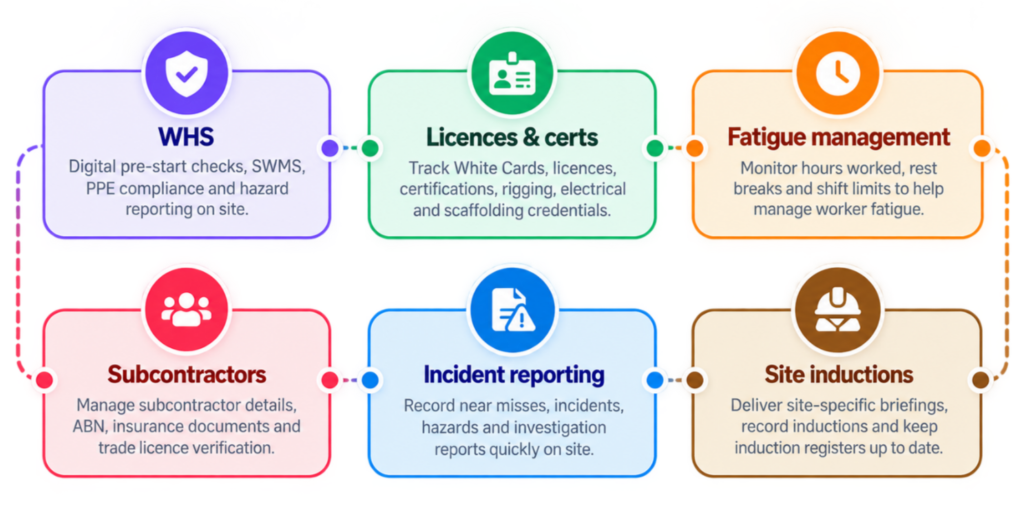
Common areas include:
Work health and safety: Identifying hazards, implementing appropriate controls and documenting safety procedures.
Worker qualifications and licences: Confirming that workers hold the required and current credentials for their duties.
Site inductions: Ensuring workers understand site-specific hazards, emergency arrangements and workplace rules.
Pre-start inspections: Recording relevant checks of equipment, vehicles and work areas before use.
Incident reporting: Documenting incidents, injuries, hazards and near misses, and notifying the relevant regulator when legally required.
Working hours and timesheets: Maintaining accurate records of hours worked, breaks and other employment information.
Contractor documentation: Checking relevant qualifications, insurance documents and other project-specific requirements.
Personal protective equipment (PPE): Providing required equipment and ensuring applicable safety procedures are followed.
These activities involve more than keeping documents in a folder. Businesses need processes to check that information remains current, required checks are completed and records can be retrieved when needed.
Australian Construction Compliance Requirements
Construction businesses should understand which laws and regulatory requirements apply to their projects rather than assuming that one checklist covers every jurisdiction.
Work health and safety obligations
Australian WHS laws establish duties for businesses and individuals involved in work, including construction activities. The specific legislation and requirements depend on the jurisdiction.
Safe Work Australia publishes model WHS laws and guidance, but the model laws are not automatically the applicable legislation in every state and territory.
Read the official guidance: Safe Work Australia — Model WHS Laws.
Depending on the project and work activities, businesses may need to manage:
Site-specific WHS management plans.
Safe work method statements (SWMS) for high-risk construction work.
Hazard identification and risk controls.
Equipment and plant inspections.
Worker consultation and safety communication.
Emergency procedures.
Incident notification and recordkeeping.
Businesses should also confirm whether principal contractor duties apply to their project and understand the requirements that accompany those responsibilities.
Worker licences and qualifications
Some construction activities require specific licences, certifications or other evidence of competency. Examples may include high-risk work involving cranes, dogging, rigging and scaffolding, as well as electrical work and asbestos removal.
A Construction Induction Card, commonly called a White Card, is generally required for people carrying out construction work, subject to the applicable legal requirements.
Before allocating work, businesses should check:
Which qualifications are required for the particular task.
Whether the worker’s credentials are current.
Whether the licence or certification is valid for the relevant jurisdiction.
Whether any additional training, site authorisation or competency assessment is necessary.
When each credential expires and when renewal action is required.
Requirements differ between occupations and jurisdictions. Always confirm the applicable rules with the relevant licensing authority or regulator.
Employment records and working hours
Construction businesses must also comply with applicable employment laws, industrial instruments and workplace agreements.
The Fair Work Ombudsman provides official information about pay, hours of work, recordkeeping and employee entitlements.
Accurate time and wages records are particularly important for businesses managing multiple workers, changing shifts, overtime and payroll processing. Under the Fair Work Act, employers generally need to retain required time and wages records for seven years.
Digital timesheets can help businesses maintain consistent records, but the employer remains responsible for ensuring that its records meet the applicable legal requirements.
Fatigue and fitness for work
Long shifts, night work, physically demanding tasks and insufficient recovery time can increase fatigue-related risks.
Businesses should consider working hours, rest periods, the nature of the work and any applicable fatigue-management requirements when planning shifts.
The Comcare fatigue guidance provides information about fatigue as a workplace risk.
Roster planning and reliable timesheet records can support fatigue-management processes, although software records alone do not establish that a worker is fit for work or that all WHS obligations have been met.
Construction Site Compliance Checklist
Use the following checklist as a starting point for reviewing your site’s procedures. Adapt it to the project, the work being undertaken and the applicable state or territory requirements
Before work starts
Confirm that workers have the required construction induction credentials.
[ ] Complete and record the site-specific induction for each worker where required.
[ ] Verify relevant licences, certifications and qualifications.
[ ] Review and communicate applicable SWMS for high-risk construction work.
[ ] Complete required pre-start checks for plant, equipment and vehicles.
[ ] Confirm that emergency procedures and first-aid arrangements are in place.
[ ] Check that required PPE is available and suitable for the work.
[ ] Confirm that contractors have supplied the required project documentation.
[ ] Ensure workers understand their duties, site rules and reporting procedures.
During the project
[ ] Record attendance and working hours accurately.
[ ] Complete scheduled inspections and safety checklists.
[ ] Report hazards, incidents, injuries and near misses promptly.
[ ] Record corrective actions and follow up outstanding issues.
[ ] Monitor compliance with site procedures and PPE requirements.
[ ] Maintain relevant contractor and worker documentation.
[ ] Review working hours and rest arrangements where fatigue risks exist.
[ ] Keep required records accessible to authorised managers and supervisors.
Weekly and monthly reviews
[ ] Review upcoming licence and certification expiry dates.
[ ] Follow up missing or incomplete compliance forms.
[ ] Check timesheets and resolve discrepancies before payroll processing.
[ ] Review incident reports and outstanding corrective actions.
[ ] Check that induction and training records are current.
[ ] Review contractor documentation and insurance expiry dates where applicable.
[ ] Confirm that required records are being retained for the appropriate period.
[ ] Update procedures when project conditions or regulatory requirements change.
Why a documented checklist matters
A checklist gives supervisors and managers a repeatable process instead of relying on memory or informal conversations. It also helps identify missing information before it becomes a larger operational problem.
However, completing a checklist does not automatically establish legal compliance. Businesses must ensure that the checks are appropriate, that identified issues are addressed and that any required notifications or other actions are completed.
How Digital Tools Can Simplify Construction Compliance
Paper forms, spreadsheets, email reminders and separate timesheet systems can make it difficult to maintain a consistent view of workforce activities.
Digital workforce management tools can help bring selected processes together, making it easier for managers to see what has been recorded and what still requires attention.
Digital forms and inspections
Digital forms can be used to record site inspections, pre-start checks, inductions, safety observations and other workplace procedures.
Depending on the form and its configuration, a digital submission can capture responses, supporting notes and a record of when it was submitted.
A well-designed process should also identify who is responsible for completing each form, when it is required and what happens when a response indicates that follow-up action is needed.
Licence and certification records
Maintaining a central record of worker qualifications can help managers review credential details and upcoming expiry dates.
Useful information may include the licence type, licence number, issuing authority, start date, expiry date and a copy of the supporting document.
Businesses should establish a clear process for reviewing documents and verifying credentials where required. Recording a licence in a system is not the same as independently validating it with the issuing authority.
Rostering and timesheets
https://clicktime.com.au/Accurate rosters and timesheets help businesses understand who is assigned to a shift and record the hours actually worked.
Comparing scheduled shifts with recorded attendance can help identify discrepancies that require investigation before payroll is finalised.
Reliable time records can also support management reviews of working hours and rest arrangements. Any fatigue-related decisions must still account for the relevant circumstances and legal obligations.
Incident and corrective-action records
https://clicktime.com.au/all-features/daily-log/A consistent digital reporting process can help workers and supervisors document incidents, hazards and near misses.
Businesses should record the relevant details, assign responsibility for follow-up where appropriate and track corrective actions through to completion.
Digital records should be stored securely, made accessible to authorised people and retained in accordance with applicable requirements.
Centralised workforce information
When workforce records are spread across different files and systems, managers may spend unnecessary time locating information.
A workforce management platform can help organise information about employees, shifts, attendance and related operational records, depending on the platform’s available features.
The objective is not simply to digitise paperwork. It is to establish a consistent process that helps managers maintain accurate records and act on missing or outdated information.
Using ClickTime to Manage Workforce Records and Forms
ClickTime is a workforce management platform designed to help Australian businesses manage their workforce, rostering, attendance, timesheets and related operational processes.
For construction businesses, tradies and labour hire providers, these functions can support the administrative processes involved in managing workers across different sites and shifts.
Digital forms for site procedures
ClickTime’s digital forms functionality can be used to create and complete workplace forms on mobile devices.
Depending on how a business configures its forms, these may include:
Site inspection checklists.
Pre-start forms.
Worker induction questionnaires.
Safety observations and incident reports.
Other operational and compliance-related forms.
Digital submissions help organise completed information and reduce reliance on paper-based processes.
Businesses should configure each form to suit the relevant procedure, including when it must be completed and who is responsible for submitting it.
Worker licence and certification management
ClickTime supports the recording and management of worker licences, certificates and expiry information.
Businesses can use these records to organise credential information and identify documents that need review or renewal.
For construction employers, this can help maintain visibility of qualifications associated with particular workers. Managers should still verify credentials with the relevant issuing authority where required and confirm that workers meet the requirements of their assigned duties.
Timesheets and payroll workflows
ClickTime helps businesses manage timesheets and supports payroll workflows through integrations with Xero and MYOB.
Maintaining consistent time records can reduce manual administration and make it easier to review hours before payroll processing.
Businesses remain responsible for checking the accuracy of their records and ensuring that their payroll and recordkeeping practices comply with applicable workplace laws and industrial instruments.
Bringing workforce processes together
For businesses managing multiple sites, contractors and changing rosters, having workforce information organised within a workforce management platform can make everyday administration easier.
ClickTime can support the workforce management side of construction operations. It should be used alongside the business’s WHS procedures, competent supervision, appropriate regulatory checks and any specialist systems required for safety or project management.
The best starting point is to identify which processes currently rely on paper, spreadsheets or manual reminders, then determine which of those processes ClickTime can appropriately support.
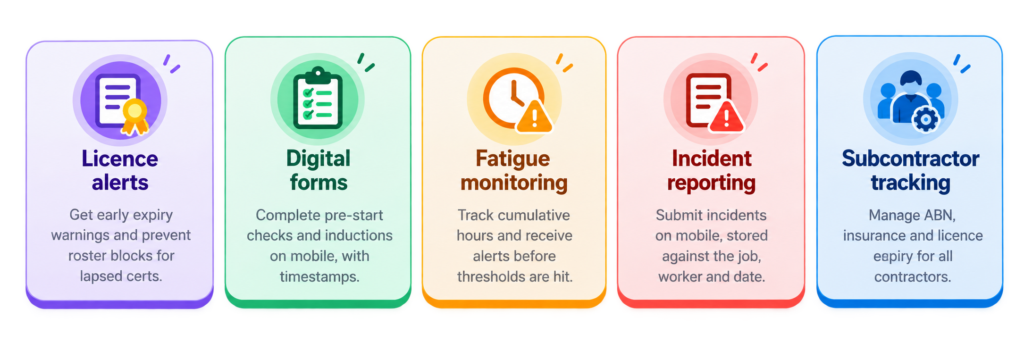
How ClickTime handles compliance for field teams
Final Thoughts
Effective construction site compliance depends on clear procedures, accurate records, appropriate supervision and regular follow-up. A practical checklist helps businesses establish consistent routines, while digital tools can make workforce information easier to organise and retrieve.
Review your existing processes, identify where records are being missed or duplicated, and establish a clear responsibility for each required check.
ClickTime can help construction businesses, tradies and labour hire providers organise important workforce management activities, from rostering and attendance to timesheets, digital forms and worker credential records.
Explore ClickTime to learn more about managing your workforce and operational processes in one platform.
Frequently Asked Questions
A construction compliance checklist should cover applicable WHS procedures, worker inductions, licences and qualifications, equipment inspections, SWMS where required, emergency arrangements, incident reporting, PPE, contractor documentation and accurate working-hour records. The checklist should be tailored to the project and the applicable jurisdiction.
A White Card is generally required for people carrying out construction work in Australia, subject to applicable legal requirements. Businesses should check the relevant rules and verify the worker’s credentials where necessary before work begins.
Some checks must occur before work starts or before particular activities take place. Other records should be reviewed at regular intervals, such as weekly or monthly, depending on the risk, project requirements and applicable laws. Licence expiry dates should be monitored so that renewals can be addressed before credentials expire.
Retention periods vary according to the type of record and the applicable legislation. For example, required time and wages records under the Fair Work Act generally need to be kept for seven years. Certain WHS incident records have separate retention requirements. Businesses should check the rules that apply to each record type rather than use one retention period for everything.
Digital forms can help businesses record inspections, inductions and other workplace procedures. Whether a particular digital record meets a legal or contractual requirement depends on the relevant rules and how the record is created, stored, retained and accessed.
Workforce management software can support selected administrative processes, including rostering, attendance, timesheets, worker records and digital forms. It does not replace a business’s legal responsibilities, site supervision, risk assessments or the need to verify qualifications with the relevant authorities.
ClickTime provides workforce management functionality, including rostering, attendance, timesheets, digital forms and worker licence and certification records. These tools can help businesses organise workforce information and related administrative processes across their operations.